
Zenzy App is one of those Android names that can look suspicious because most users do not remember installing it. If you saw “Zenzy” or “Zenzy App” on a Realme phone, the safest first step is not to panic and not to download a random “remover” APK. Treat it like any unfamiliar preinstalled or bundled Android app: identify where it came from, check permissions, then disable or remove it only if your phone allows it.
Quick answer: Zenzy App is usually searched as a Realme or Android preinstalled-app question, so the right move is to verify it inside Settings > Apps before deciding whether to keep, disable, or uninstall it.
What is Zenzy App?
Zenzy App appears in search data as a device-specific Android app query, especially around Realme phones. For a normal user, the important question is not only “what company made it?” but also “what is it allowed to do on my phone?” Android apps can be harmless system companions, regional service apps, app-store components, notification utilities, or third-party bundles added by a device vendor or carrier.
Because app inventories vary by country, device model, Android version, and firmware build, you should verify the app on your own device rather than relying on a copied APK description from the web. The most useful evidence is in Android settings: package name, installed source, permissions, battery usage, mobile-data usage, and whether the uninstall button is available.
Why does Zenzy App appear on Realme phones?
Realme and other Android brands often ship phones with a mix of system apps, regional services, app recommendations, support tools, browser components, game hubs, payment or wallet integrations, and partner apps. Some are clearly branded. Others have short names that do not explain their purpose.
If Zenzy App came with the phone after a firmware update, it may be connected to a bundled service or regional software package. If it appeared after installing an APK from outside Google Play, treat it more cautiously. The source matters.
Is Zenzy App safe?
You cannot judge safety from the app name alone. A better safety check is to look at behavior and permissions. An app with no sensitive permissions, no unusual battery drain, and no aggressive notifications is less concerning than an unknown app asking for SMS, contacts, accessibility access, overlay permission, notification access, or install-unknown-app privileges.
| What to check | Where to look | What it means |
|---|---|---|
| Installed source | Settings > Apps > Zenzy App > App details | Helps separate Play Store, system, and sideloaded apps. |
| Permissions | Settings > Apps > Permissions | Camera, microphone, SMS, contacts, location, and accessibility deserve extra review. |
| Battery usage | Battery settings | High background use can indicate an app is doing more than expected. |
| Data usage | Mobile data or Wi-Fi usage | Unexpected network activity is a reason to restrict or disable the app. |
| Uninstall button | App info screen | If uninstall is blocked, try Disable rather than force-removal first. |
How to check Zenzy App permissions
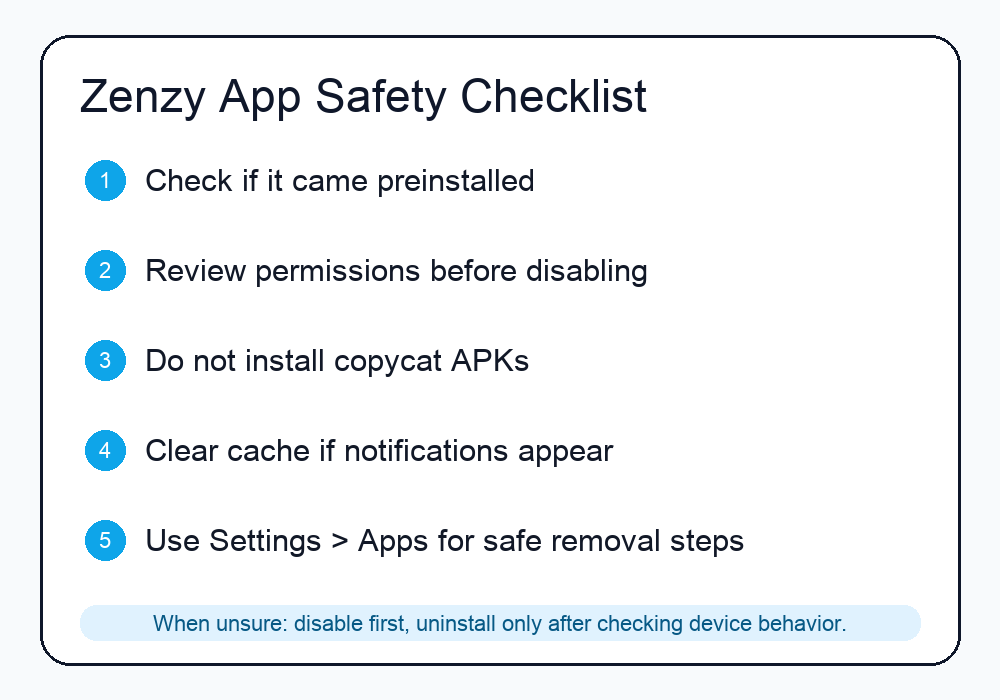
- Open Settings on your Realme or Android phone.
- Go to Apps, App management, or See all apps.
- Search for Zenzy.
- Open the app info page and review permissions, notifications, battery use, and data usage.
- If permissions look excessive, revoke them one by one before deleting anything.
If you are researching other unfamiliar preinstalled finance or Android service names, TechDuker’s FinShell Pay explainer uses a similar method: identify the source, separate rumor from device evidence, and avoid risky third-party APK downloads.
Can you disable or uninstall Zenzy App?
On many Android phones, regular apps can be uninstalled from the app info page. Some bundled apps only allow Disable. Disable is usually the safer first option because it stops the app from running while keeping the phone’s original software state easier to restore.
Safe disable steps
- Open the Zenzy App info page.
- Tap Force stop if the app is actively running.
- Clear cache only if notifications or errors keep appearing.
- Tap Disable if available.
- Restart the phone and check whether calls, messages, payments, app store, system update, and notifications still work normally.
When to avoid force-removal
Do not use ADB or root removal unless you know the app’s package role. Removing a vendor component can break software updates, regional services, or notification channels. If the app is not consuming battery, not sending notifications, and not holding sensitive permissions, disabling it is usually enough for ordinary users.
What if Zenzy App keeps coming back?
If Zenzy App reappears after an update, it may be part of the firmware or a vendor app bundle. In that case, check whether the phone has a system app updater, app recommendation setting, or regional content service enabled. You can also turn off notifications and background data for the app if uninstall is unavailable.
If it reappears after installing apps from outside Google Play, remove the recent APKs, scan the device with Play Protect, and change passwords for sensitive accounts if you granted unusual permissions.
Zenzy App vs suspicious copycat APKs
The biggest risk is often not the original app name but a copycat APK using the same keyword. Search results and forum threads may offer “Zenzy App download” files. Avoid them. Installing a random APK can create the exact security problem you were trying to solve.
Use only the phone’s built-in settings, Google Play, the vendor’s official app store, or official support pages. If an article or video asks you to install a separate cleaner, booster, or remover app, be skeptical.
Zenzy vs FinShell Pay: how to judge unfamiliar Realme or OPPO preinstalled apps
Many readers find Zenzy App while checking a Realme phone, then see another unfamiliar name such as FinShell Pay on OPPO or realme devices. The safe way to handle both is not to panic-delete the first app you notice. First classify what kind of app it is, then decide whether to restrict, disable, or simply monitor it.
| App pattern | What to check first | Safer action |
|---|---|---|
| Vendor or regional service app | Installed source, package name, app info page, whether it arrived after a system update | Disable notifications and review permissions before uninstalling |
| Finance or payment-related app, such as FinShell Pay | Country, owner, payment permissions, SMS or contact access, and whether you actually use the service | Do not enter payment data until you verify the app source and official support information |
| Suspicious copycat APK | Whether it was sideloaded, asks for Accessibility access, or came from a download site | Remove the APK, scan with Play Protect, and follow an Android malware safe-mode checklist if behavior looks abnormal |
Simple rule: a preinstalled app is a verification question; a random APK download is a security risk. If Zenzy, FinShell Pay, or another app cannot be uninstalled normally, use Android Settings to restrict sensitive permissions first. Force-removal with ADB should be the last step, not the starting point.
Five-minute permission triage
- Open Settings → Apps → Zenzy App → Permissions.
- Write down any sensitive access: SMS, Contacts, Location, Camera, Microphone, Accessibility, Notification access, and background data.
- If the app is payment-related or finance-related, compare it with the FinShell Pay country, owner, and safety guide before entering personal or payment details.
- If the app appeared after sideloading, remove the recent APK first instead of blaming every preinstalled app.
- After disabling or restricting permissions, restart the phone and test calls, messages, app updates, and notifications.
OPPO and Realme bloatware checklist: when to keep, restrict, or disable an app
Zenzy App and FinShell Pay sit inside a wider question many Android users search for: which OPPO or Realme preinstalled apps are normal regional services, and which ones deserve extra caution? The answer is rarely “delete everything.” A safer approach is to sort the app by function, permission level, and whether you actually use it.
Think in three actions: keep harmless system helpers, restrict apps with sensitive permissions, and disable apps you do not use after checking that phone basics still work. This avoids breaking updates, payments, notifications, or carrier functions while still reducing unnecessary data exposure.
| App type you see | Risk signal to check | Recommended action |
|---|---|---|
| System helper or vendor service | Cannot uninstall, low battery/data use, no sensitive permissions | Keep it, but turn off notifications if it is noisy |
| Payment, finance, wallet, credit, or rewards app | SMS, Contacts, Location, Phone, or background data access | Restrict permissions unless you actively use the service; verify country and owner first |
| Game center, browser, app market, cleaner, or recommendation app | Push ads, install prompts, usage tracking, or notification spam | Disable notifications, deny unnecessary permissions, then disable if Android allows it |
| Unknown APK with the same name as a real app | Sideloaded source, Accessibility request, Device Admin request, or strange pop-ups | Remove it and run Play Protect; do not log in or enter payment details |
Quick audit for Realme or OPPO users
- Open Settings → Apps → App management and sort by recently installed or recently used.
- For Zenzy, FinShell Pay, or any unfamiliar app, open App info → Permissions and note sensitive access.
- Check Mobile data and Battery. An unused preinstalled app that runs constantly deserves restriction.
- Search the exact package name, not only the display name. Copycat APKs often reuse familiar app names.
- Disable first, restart the phone, then test calls, messages, camera, Play Store, system update, banking/payment apps, and notifications.
This checklist also explains why a finance-adjacent preinstalled app should be treated differently from a wallpaper app. You do not need to assume it is malicious, but you should not give payment, SMS, contact, or accessibility permissions before you understand what the app does.
FAQ
Is Zenzy App a virus?
Not necessarily. The name alone is not enough to call it a virus. Check installed source, permissions, battery usage, data usage, and whether it appeared after a firmware update or after sideloading an APK.
Should I uninstall Zenzy App from Realme?
If Android allows a normal uninstall and you do not use the app, uninstalling is reasonable. If only Disable is available, disable first and monitor whether the phone behaves normally.
Why can’t I uninstall Zenzy App?
Some Android apps are installed as system or vendor apps. These may only allow Force stop, Disable, or permission restriction. Do not force-remove them unless you understand the package dependency.
Can Zenzy App access my personal data?
Only permissions and behavior can answer that. Review whether it has access to contacts, SMS, microphone, camera, location, accessibility, notification access, or background data.
Is it safe to download Zenzy App APK?
No. If the app is already on your phone, manage it from Android Settings. Downloading third-party APKs with the same name increases risk and is not needed for safety checks.
Bottom line
Zenzy App is best handled as an unfamiliar Android or Realme app: verify it locally, restrict permissions, disable before force-removing, and avoid copycat APK downloads. For more phone and app explainers, follow TechDuker’s practical technology coverage and compare with our guide to Meta smart glasses for another example of separating feature claims from real-world user checks.
CTA: If you found Zenzy App after a Realme update, bookmark this checklist and review the app again after your next firmware update.
